Over the past years, INEKA ((Institute of Education and Innovation, formerly AKETH) has developed and implemented a dynamic portfolio of European projects and innovative educational products, reflecting its strong commitment to excellence in vocational education, digital transformation, and social inclusion. Through active participation in Erasmus+ and other European initiatives, the organisation has designed and delivered
impactful solutions ranging from AI-powered learning tools and digital platforms to training programmes, research outputs, and capacity-building resources. The projects featured here represent a curated selection of initiatives that the organisation is particularly proud of,
and do not reflect the full breadth of INEKA's involvement across European programmes.
This portfolio highlights INEKA's continuous contribution to advancing skills development, fostering innovation, and supporting diverse target groups across Europe through high-quality, collaborative, and future-oriented interventions.

AI2SCHOOL chatbot
The AI2SCHOOL chatbot, at the heart of the Human2AI initiative, is an innovative, studentfocused conversational assistant designed to bring generative AI into secondary school classrooms. As part of PR3—“AI2SCHOOL Platform and Chatbot”—this tool was created to engage learners in realworld applications of AI, offering interactive, ondemand support for classroom activities across diverse subjects. Deployed through the userfriendly AI2SCHOOL web platform, the chatbot supplements workshops and training modules with responsive guidance, formative feedback, and enrichment, helping students build foundational AI skills within the DigComp 2.2 framework . Empowered by generative AI, it not only stimulates critical thinking around AI’s potential and ethical implications but also promotes personalized learning, making it a dynamic educational companion in the digital classroom environment.
Virtual museum guided tours
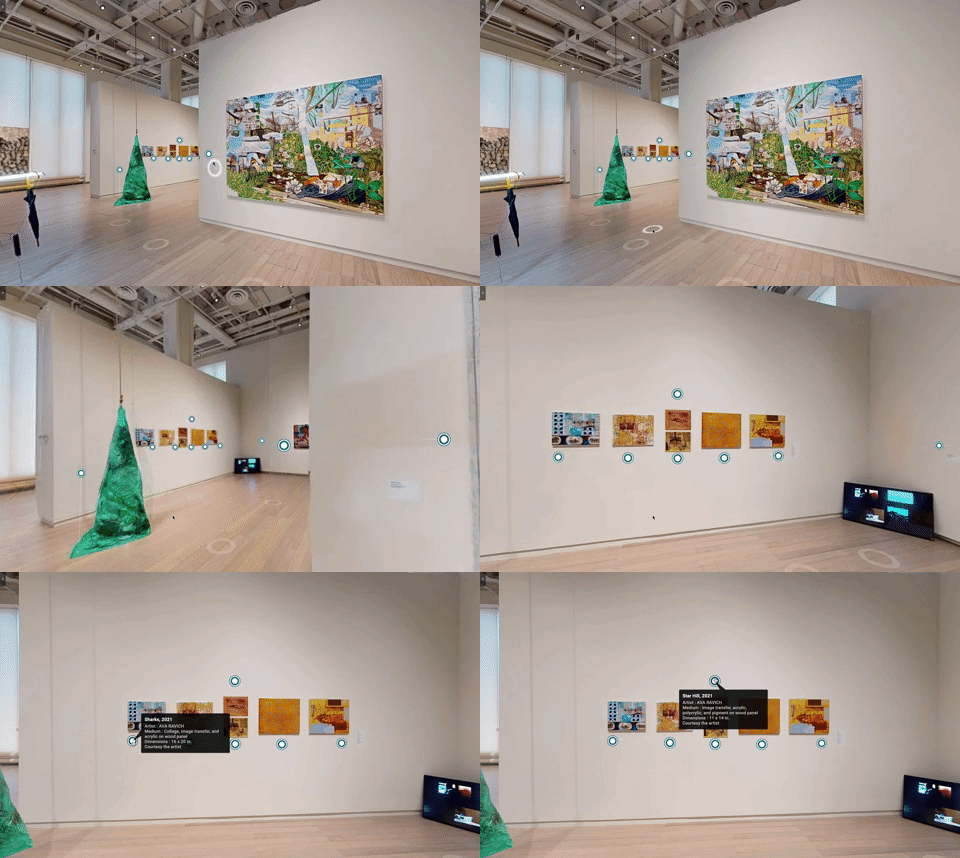
The MonA (Museopedagogy and Augmented Reality) digital tour is an immersive virtual guided experience designed for four partner museums—Kunstmeile Krems, NEMO Science Museum, MusicMuseum Vassilis Tsitsanis, and Palazzo Lucarini. Developed as IO2, this tour allows students and educators to explore museum exhibitions virtually, combining 360° panoramic navigation with rich multimedia content tailored for school group. It is part of an integrated educational suite that includes an augmentedreality game (IO3) and a companion smartdevice app (IO4) that merges both elements, enabling interactive storytelling, quizzes, and learning prompts during or after the visit monaproject.eu. The userfriendly platform supports virtual museum tours across multiple devices, making cultural heritage accessible regardless of location, and transforming traditional school visits into playful, educational journeys anchored in museum pedagogy and modern tech. It's a powerful blend of content, interactivity, and engagement that brings museum learning to life for younger audiences.
STEAM in primary education – A Reference Guide
The book produced within the STEAMedu project is a comprehensive, educator-focused guide that supports the newly developed MSc programme in STE(A)M education. It blends theoretical foundations with practical learning, offering multidisciplinary curriculum frameworks, detailed syllabi, and digital resources designed for teachers and academic staff in Western Balkan and EU institutions. Featuring modules on curriculum design, laboratory infrastructure, virtual learning environments, and professional development strategies, the book equips educators to foster interdisciplinary, inquiry-based learning and to manage STEAM labs effectively. By integrating hands-on methodologies with digital tools, it empowers educators to enrich their teaching, build capacity, and drive long-term innovation in STE(A)M education across partner countries
Play & Learn – Interactive Educational Game for Cultural Heritage Exploration
The Interactive Educational Game for Primary School Students, developed within the Play & Learn Erasmus+ project (2021-1-EL01-KA220-SCH-000027810), is a location-based digital learning application that combines cultural exploration with game-based education. Designed for primary school learners, the game allows users to select their language and explore culturally significant sites through an interactive map, multimedia content, and engaging activities such as quizzes, riddles, and matching games. Available across four European partner cities—Trikala (Greece), Foligno (Italy), Iași (Romania), and Istanbul (Turkey)—the application enables students to discover diverse cultural environments through a unified interactive platform. Each city offers location-based activities and educational content, encouraging learners to engage with local history and heritage in an immersive and playful way. By motivating students to explore points of interest, access educational information interactively, and earn points through participation, the game promotes active learning, cultural awareness, and motivation. It can be used both as an educational support tool for schools and as an engaging resource for informal learning experiences beyond the classroom.
Ancient Tech Quest: Virtual Reality-Based Interactive Educational Game
The Ancient Tech Quest is an interactive educational game developed by INEKA’s STEAM/Robotics Team, aiming to introduce learners to the technological achievements of ancient civilizations through game-based learning. The project was created in the context of the team’s participation in international robotics and STEAM competitions, where it formed part of their Innovation Project, focusing on transforming historical knowledge into an engaging digital experience. The application combines storytelling, challenges, and interactive exploration, allowing users to discover inventions, tools, and innovations from the past in an immersive and meaningful way. The project received significant recognition, including the Breakthrough Award in the FIRST® LEGO® League Challenge UNEARTHED League, highlighting both the educational value and the technical quality of the solution. By applying modern pedagogical approaches such as experiential learning and interdisciplinarity, the game supports the development of creativity, critical thinking, and problem-solving skills. It can be used in both formal and informal learning environments, promoting cultural and technological awareness through innovative digital tools.
Ocean Guard: Virtual Reality-Based Educational Game for Marine Awareness
The Ocean Guard is an innovative educational application developed by INEKA’s STEAM/Robotics Team, aiming to raise awareness about marine ecosystems and environmental sustainability through immersive, technology-enhanced learning. Created in the context of the team’s participation in international robotics and STEAM competitions, the project served as their Innovation Project, transforming environmental education into an engaging digital experience. Using virtual reality (VR) technology, the application allows users to explore the ocean floor, interact with marine life, identify threats such as pollution, and complete missions related to ocean protection. Through storytelling, interactive challenges, and experiential exploration, learners develop a deeper understanding of marine ecosystems and sustainable practices. The project received important recognition, including the Innovation Project Award in the FIRST® LEGO® League Challenge, highlighting both its educational value and technological innovation. Designed for use in both formal and informal learning environments, Ocean Guard promotes creativity, critical thinking, and environmental responsibility through accessible digital tools.
Educational Virtual Tour Platform: Interactive Cultural Heritage Learning Experience
The Educational Virtual Tour Platform, developed within the Folk Art & Culture Erasmus+ project (2022-1-EL01-KA220-ADU-000088666), is an innovative digital learning environment that offers access to four immersive virtual tours hosted on a single platform. The tours present the collections of the Museum of Pialeia (Greece), Bursa Museum (Türkiye), Mercato delle Gaite (Italy), and Hârlău Museum / Moldova National Museum Complex of Iași (Romania), allowing users to explore folklore, local history, and cultural heritage through interactive online experiences. Combining 360° virtual navigation with multimedia hotspots, videos, images, descriptive content, quizzes, and a score system, the platform transforms museum visits into engaging educational journeys for both learners and the wider public. INEKA played a key role in the development of the platform, including technical guidelines, content integration, and overall system design, contributing significantly to its usability and educational value.
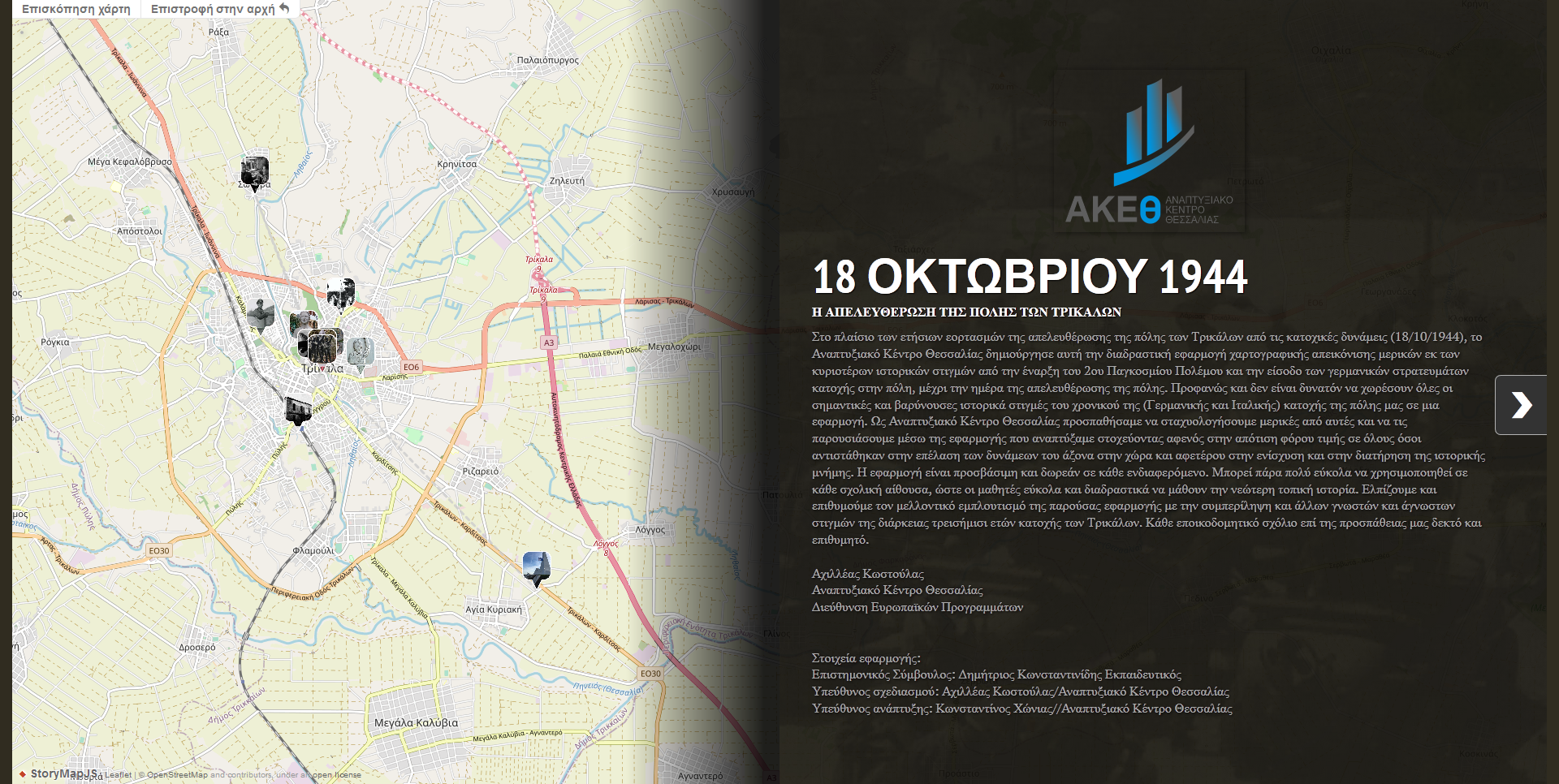
Trikala Liberation: Interactive Digital History Learning Platform
The Trikala Liberation platform is an interactive digital learning environment that combines history with modern educational technology, presenting the liberation of Trikala in 1944 through multimedia content, archival material, and digital storytelling. Designed as a non- linear and interactive experience, it enables users to explore historical events in an engaging and immersive way. The platform supports experiential and inquiry-based learning, making it suitable for secondary education, classroom use, and project-based activities, while also serving as a resource for informal learning and community engagement. It reflects INEKA’s commitment to integrating history, education, and digital innovation into accessible learning experiences.
AktiSOS: Interactive Environmental Innovation Application
The AktiSOS project is an innovative environmental application developed by INEKA’s STEAM/Robotics Team, focusing on smart waste management and the protection of coastal areas through technology-driven solutions. Created as an evolution of the project The Mediterranean Sends SOS, AktiSOS introduces a network of IoT-enabled recycling bins that monitor fill levels in real time and transmit data to an online platform, enabling efficient waste collection and management. The system is complemented by a user-friendly application that allows citizens to report issues such as pollution or infrastructure problems, promoting active community participation. The project achieved significant recognition at the RoboRAVE 2026 Europe Open, where the team won 1st place in the Judge’s Choice Awards and 2nd place in the People’s Choice Awards in the Entrepreneurship category, while also qualifying for the RoboRAVE International World Final in Osaka, Japan. By combining environmental responsibility, digital innovation, and community engagement, AktiSOS demonstrates how student-led innovation can deliver impactful solutions to real- world challenges.
The City Narrates Its Small Stories – Trikala: Interactive Cultural Route and Educational Treasure Hunt
The “The City Narrates Its Small Stories – Trikala” initiative is an interactive educational experience that combines guided tours, cultural exploration, and treasure-hunt activities to help students discover the historical layers of the city of Trikala. Organised by the Ephorate of Antiquities of Trikala in collaboration with INEKA, the action was implemented in the framework of the European Heritage Days and engaged approximately 200 students from the final grades of primary school and lower secondary education. Participants explored the archaeological site of ancient Trikke, the post-Byzantine churches of Varousi, and the Archaeological Collection of Trikala, using contemporary technologies such as GPS, QR codes, augmented reality, and robotics to unlock stories connected to health, healing, and the city’s past from antiquity to modern times. The project transformed cultural heritage into an enjoyable and immersive learning journey, promoting active participation, local history awareness, and experiential learning through digital innovation.

EN.GA.G.E. Digital Games on ENtrepreneurhip
Developed as part of the EN.GA.G.E. (ENtrepreneurial GAmes for Growing Europeans) Erasmus+ KA2 Strategic Partnership project (2017-1-IT02-KA201-036947), two digital games were designed to introduce entrepreneurial thinking to primary and secondary school students across Europe through experiential, game-based learning. In the primary school game, players take on the role of a class committee member organizing an end-of-year party, exploring four city-themed levels representing partner countries, collecting recyclable materials and coins, solving entrepreneurship and environmental quizzes, and spending their earnings in in-game shops to fund the event. The secondary school game shifts to a business simulation where players manage a company with a fixed starting budget, collect and process raw materials into finished goods, hire employees to optimize production, and make human resources decisions — such as wages and working conditions — that directly affect team performance. Together, the two games offer an age-appropriate progression from basic entrepreneurial concepts to hands-on business management, embedding sustainability and teamwork values throughout.
Download games here (require Windows PC)